

Buying one pair of budget headphones that handles music enjoyment, video calls, and noisy commutes sounds impossible — but in 2025, the sub-$100 wireless headphone category has matured enough that certain models genuinely cover all three scenarios without the compromises that made this a pick-two situation three years ago. The best budget headphones don’t excel at everything equally, but they perform adequately across music, work, and travel — eliminating the need for multiple pairs that collectively cost more than a single premium headphone would have.
Best budget headphones for multi-use are wireless headphones priced under $100 that deliver acceptable performance across three core scenarios: music listening (sound quality and bass response), work use (microphone clarity for calls and comfort for 4+ hours), and commuting/travel (noise isolation or ANC, battery life, portability). The “best” isn’t the one with the highest spec in any single category — it’s the one with the most balanced performance across all three.
This guide identifies which budget headphones actually deliver this three-way balance and which sacrifice one use case dramatically to excel at another — so you don’t discover the mismatch after the return window closes.
Can One Pair of Budget Headphones Really Handle Music, Work, and Travel?
Yes — but only specific models engineered for versatility rather than single-use-case dominance. A headphone optimized purely for bass-heavy music often has mediocre microphones. One designed for call clarity may lack the ANC needed for commuting. The sweet spot exists in models that deliberately balance all three.
What each use case actually demands:
| Use Case | Critical Feature | Secondary Feature | Nice-to-Have |
|---|---|---|---|
| Music | Balanced sound with adequate bass | Codec support (AAC minimum) | EQ customization via app |
| Work (Calls) | Clear microphone with noise reduction | Comfort for 4+ hour sessions | Multipoint (connect laptop + phone) |
| Commuting/Travel | ANC or strong passive isolation | Battery life 20+ hours | Foldable design for portability |
A headphone that delivers all six “critical” and “secondary” features under $100 is your target. The “nice-to-haves” separate good from great but shouldn’t drive your decision at budget pricing.
Which Budget Headphones Under $100 Balance All Three Use Cases Best?
The Soundcore Space One ($79), Sony WH-CH720N ($78), and Nothing Ear (a) ($99) represent the best multi-use budget options in 2025. Each delivers competent ANC, respectable sound quality, adequate microphone performance, and 20+ hour battery life.
Top multi-use budget headphones compared:
- Soundcore Space One ($79): Best ANC in the budget tier. 40mm drivers with punchy bass. Good microphone for calls. 50-hour battery without ANC. LDAC support on Android. Foldable. Weak point: slightly heavy at 265g.
- Sony WH-CH720N ($78): Lightest premium-feeling budget headphone at 192g. Decent ANC. Clear V1-chip-powered microphone. 35-hour battery. Multipoint connection. Weak point: plastic-dominant build feels less durable.
- Nothing Ear (a) — Earbuds ($99): If you prefer earbuds over over-ear. Excellent ANC for the price. Good call quality. 5.5-hour bud life (24 with case). IP54 sweat resistance for active commutes. Weak point: earbud fatigue for 4+ hour sessions.
- JBL Tune 770NC ($79): Excellent sound quality with JBL’s signature bass. Decent ANC. Good comfort. 44-hour battery. Weak point: microphone clarity below average for the category.
- Edifier WH950NB ($89): Hi-res audio certified. Strong ANC. Good comfort with large pads. 34-hour battery. Weak point: companion app is less polished than Sony or Soundcore.
For detailed comparisons and current pricing, the affordable headphones review guide covers these models with use-case-specific testing results.
What Sound Quality Can You Realistically Expect Under $100?
Budget headphones in the $70–$100 range deliver 75–80% of flagship sound quality for most listeners. The gap shows in soundstage width, instrument separation in complex tracks, and sub-bass extension — areas that matter primarily for critical listening rather than everyday enjoyment.
Realistic sound expectations by price:
- Under $30: Muddy bass, recessed mids, harsh treble. Fine for podcasts and casual YouTube. Not enjoyable for music listening.
- $30–$50: Acceptable sound with V-shaped signature (boosted bass and treble, recessed vocals). Enjoyable for most genres at standard streaming quality.
- $50–$80: Good sound quality. More balanced presentation with defined bass, clear mids, and controlled treble. Suitable for enjoyable music listening across genres. Headphones for music at this tier satisfy 80% of listeners completely.
- $80–$100: Very good sound approaching mid-range quality. Better driver materials, tuning refinement, and often EQ app support. The diminishing returns curve begins steepening above this range.
The honest truth: most listeners in blind testing cannot reliably distinguish a well-tuned $80 headphone from a $250 headphone when both play Spotify at standard quality (320kbps). The quality gap reveals itself with lossless audio sources and analytical listening — situations most commuters and remote workers never encounter.
How Important Is ANC in Budget Headphones for Commuting?
ANC in budget headphones reduces ambient noise by 50–65% — less than the 75–90% of flagship models, but enough to make commuting significantly more enjoyable. Budget ANC handles steady noise (engine drone, HVAC) adequately but struggles with variable noise (conversations, announcements).
Budget ANC performance by noise type:
- Steady low-frequency noise (bus/train engine): 60–70% reduction. Noticeable and useful improvement. The primary scenario where budget ANC delivers meaningful value for commuters.
- Steady mid-frequency (HVAC, fan noise): 50–60% reduction. Appreciable difference that reduces fatigue during commutes.
- Variable mid-high frequency (conversations, announcements): 30–40% reduction. Audibly dulled but not eliminated. Budget ANC’s weakest area — voices still penetrate.
- Sudden loud noises (horns, construction): 15–25% reduction. Barely affected by ANC at any price. This is a physics limitation, not a budget limitation.
Headphones for commuting at the budget tier benefit significantly from good passive isolation in addition to ANC. Over-ear headphones with dense memory foam pads provide 15–20dB of passive noise reduction before ANC even activates — this combination makes budget ANC more effective than specs alone suggest.
What Microphone Quality Can Budget Headphones Deliver for Work Calls?
Budget headphones deliver “acceptable” call quality in quiet environments and “usable with limitations” in moderate noise. Don’t expect boardroom-quality voice isolation in a coffee shop — but for home office calls and quiet commute conversations, budget mics from Sony and Soundcore perform adequately.
Microphone performance by environment:
- Quiet home office: All budget headphones perform adequately. Your voice sounds clear, background silence is maintained. No one on the call notices you’re using $80 headphones versus $350 ones.
- Office with moderate ambient noise: Sony WH-CH720N and Soundcore Space One handle this with reasonable voice isolation. Budget competitors from JBL and Skullcandy allow more background bleed.
- Coffee shop or outdoor: Budget microphones struggle here. Voices sound thin with audible ambient noise. This is where flagship headphones with 4-mic beamforming arrays justify their premium — budget options can’t match this performance.
If video calls from noisy environments are a daily requirement, budget headphones likely won’t satisfy. For home office and quiet indoor spaces, they’re perfectly functional.
How Does Battery Life Affect Daily Multi-Use Headphone Routines?
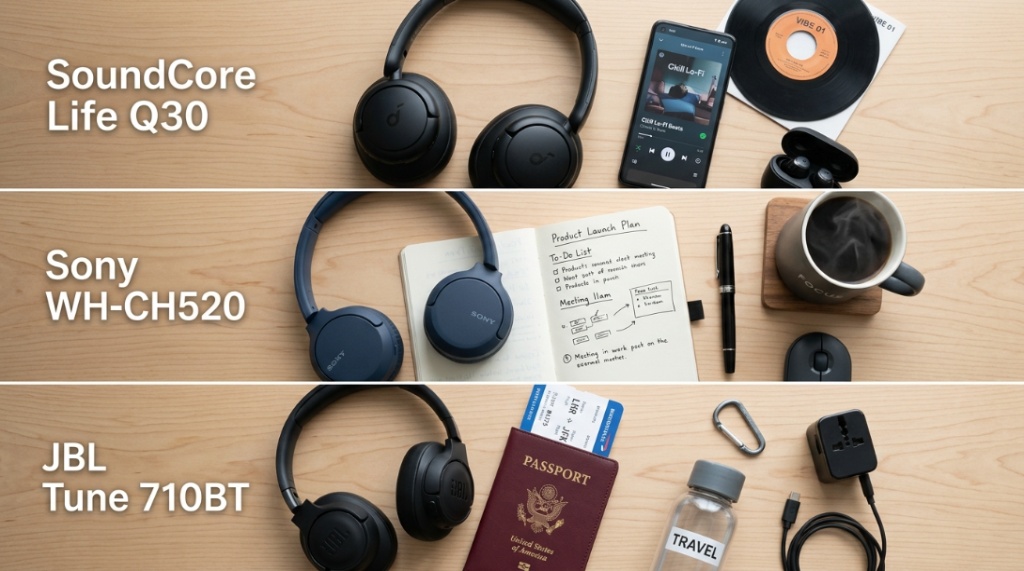
Budget headphones in 2025 offer 30–50 hours of battery life without ANC — more than enough for a full work week without charging. With ANC active (the more realistic usage), expect 20–35 hours. Either way, daily charging anxiety is eliminated at this price tier.
Battery strategy for multi-use routines:
- Daily commute + workday (10–12 hours): Any budget headphone with 20+ hour ANC battery handles this without charging mid-day. Charge overnight every 2–3 days.
- Quick-charge emergency: Most budget options offer 3–5 hours of playback from a 10-minute charge. Forget to charge overnight? A quick morning top-up covers the commute.
- Travel (long flights): 30+ hour battery covers even the longest commercial flights with hours to spare. The Soundcore Space One at 50 hours (ANC off) or 40 hours (ANC on) is particularly travel-friendly.
Battery life is one area where budget headphones in 2025 match or exceed some flagships. The Sennheiser Momentum 4 ($349) also offers 60 hours — but the Soundcore Space One at $79 matches this tier of endurance. Battery is no longer a premium-exclusive feature.
Should You Buy Over-Ear or Earbuds for Multi-Use Budget Needs?
Over-ear headphones deliver better ANC, comfort for long sessions, and microphone quality. Earbuds offer better portability, workout compatibility, and convenience for short-session multi-tasking. Choose over-ear if sessions exceed 2 hours regularly; choose earbuds if portability and quick on/off convenience dominate your routine.
Decision factors:
- Choose over-ear budget headphones if: You work from home (long sessions need comfort), commute on trains/buses (better ANC and passive isolation), or prioritize call quality (larger mic housings perform better).
- Choose budget earbuds if: You walk/bike commute (earbuds stay secure during movement), exercise regularly (sweat resistance needed), or prefer pocketing your headphones quickly between uses.
- Own both (best strategy if budget allows): Over-ear for work and travel ($79), earbuds for commuting and exercise ($50–$99). Two budget pairs still costs less than one premium pair while covering all scenarios optimally.
What Features Are Worth Paying Extra for Versus Skippable at Budget Pricing?
Worth paying for: ANC (even basic), multipoint Bluetooth connection, companion app with EQ, and 20+ hour battery. Skip at budget pricing: hi-res codecs (minimal benefit with streaming), spatial audio (gimmick at this tier), and wireless charging cases (adds $20–$40 for marginal convenience).
Feature value assessment:
- Worth it — ANC ($10–$20 premium): Even basic ANC transforms commuting comfort. Always choose ANC-equipped at budget tier.
- Worth it — Multipoint ($0–$10 premium): Connect laptop and phone simultaneously. Saves the constant Bluetooth switching between work calls and music. Not all budget models include this — check specifically.
- Worth it — App with EQ ($0): Free sound customization that lets you tune the headphone to your preference. Brands with good apps: Sony, Soundcore, Nothing. Brands with weak/no apps: JBL Tune series, most Skullcandy.
- Skip — LDAC/aptX ($0–$15 premium): Only matters with hi-res streaming subscriptions AND compatible phones. Most budget buyers stream Spotify/Apple Music at standard quality where AAC sounds identical.
- Skip — Spatial audio: Poorly implemented at budget pricing. Often sounds artificial rather than immersive. Not worth influencing purchase decisions.
Finding the sweet spot between affordability and high-fidelity sound can sometimes feel like a chore. While looking for affordable alternatives, it is always worth keeping an eye out for major brand flash sales. If you want to jump straight to a premium audio experience without paying retail markup, you can Buy Genuine Beats Headphones at Discount Prices through verified closeout distributors.
Conclusion
The best budget headphones for music, work, and travel in 2025 exist in the $70–$100 over-ear segment — specifically the Soundcore Space One, Sony WH-CH720N, or equivalent models that deliver competent ANC, respectable sound, adequate microphone clarity, and 20+ hour battery. Accept that budget headphones won’t match flagships in any single category, but appreciate that they cover all three daily use cases well enough to eliminate the need for multiple specialized pairs. That’s the real value proposition: comprehensive adequacy at one-third the price of premium single-purpose excellence.
Comparing specific models? The budget headphone reviews include head-to-head testing across music quality, call performance, and commute ANC effectiveness.
What’s your primary headphone use case — music, work calls, or commuting? Share your balance in the comments and get targeted recommendations from others with similar routines.
Frequently Asked Questions
What’s the best budget headphone for music quality specifically?
The Edifier WH950NB ($89) and Soundcore Space One ($79) deliver the best pure sound quality under $100. Both offer balanced tuning with controlled bass, clear vocals, and detailed highs. LDAC support on both provides additional quality for Android hi-res streaming. For bass-heavy preferences, the JBL Tune 770NC excels.
Can budget headphones work for professional video calls?
In quiet home offices, yes — budget headphones from Sony and Soundcore deliver professional-sounding call quality. In noisy environments (shared offices, cafes), budget microphones can’t isolate your voice cleanly enough for professional contexts. If calls from noisy spaces are daily, invest in headphones with 4+ mic beamforming arrays ($150+).
How much worse is budget ANC compared to premium ANC?
Budget ANC reduces ambient noise 50–65% versus 75–90% for premium (Bose, Sony flagship). The gap is most noticeable with human voices and variable noise. For steady noise (engines, fans, HVAC), budget ANC performs 80% as well as premium. For $250+ less, that 15–20% performance gap is acceptable for most commuters.
Should I buy budget wireless or mid-range wired headphones for the same price?
For multi-use (music + work + commuting): wireless. Wired headphones at $80 deliver superior sound quality for pure music listening but lack ANC, aren’t practical for commuting (cable management), and require a headphone jack for work laptops that increasingly lack one. Wireless versatility wins for multi-use buyers.
Do budget headphones last as long as premium ones?
Typically 1.5–2.5 years versus 3–5 years for premium. The primary difference is build material quality — budget headphones use more plastic, thinner padding, and cheaper hinge mechanisms that wear faster. Battery degradation affects all wireless headphones equally regardless of price after 2+ years of daily charging.
Are headphones for commuting different from headphones for office work?
Slightly. Commuting prioritizes ANC strength, portability (foldable), and secure fit during movement. Office work prioritizes microphone quality, extended comfort (4+ hours), and multipoint connection for laptop-phone switching. Budget headphones that deliver both sets of features exist — Sony WH-CH720N and Soundcore Space One cover both scenarios adequately.
What’s the minimum I should spend to get good headphones?
$60–$80 is the minimum for headphones that perform acceptably across music, calls, and commuting with ANC. Below $60, significant compromises appear — typically poor ANC, inadequate microphone, or uncomfortable build for extended wear. The $70–$100 range delivers the best performance-per-dollar for multi-use wireless headphones.



Leave a Reply